
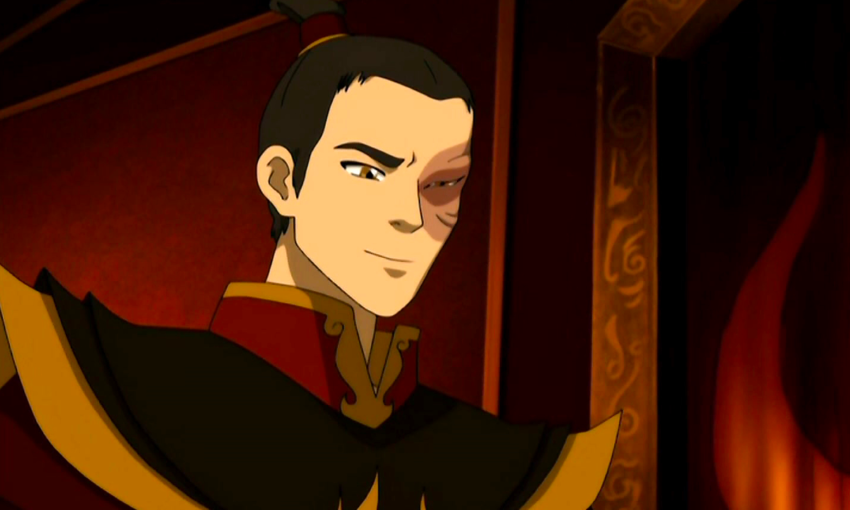
If you’ve spent almost any time at all in the Avatar fandom, you’ve probably come across the question, “why did Zuko become firelord instead of Iroh?” Iroh, the wise old sage of the series, never fails to bring broadly-applicable wisdom to every situation, pushing characters into just the right position so that they can grow and develop as they’re supposed to. His ability to judge character, help those in need, and discern exactly what kind of approach is necessary for each situation would make him an excellent leader. He’s the natural fit for the position of Firelord, both practically and storywise. There’s a unique kind of satisfaction that would come from seeing the overlooked and humble mentor fulfill a position of strength and prominence for the first time in years.
But instead, the position is handed to the famously emotional seventeen-year-old Prince Zuko. And while it’s definitely nice to see him finally begin to undo the sins of his father, the practicality of the decision has bothered many viewers.
Who would realistically agree to letting a teenager run a major world power when there is someone else more experienced who’s also qualified to take on that role? Is Iroh’s claim that he just wants to settle down to a simple life believable? Is there anything really beyond this at all, except that the writers wanted to end with a picture of Zuko being crowned Firelord?
Today we’re answering these questions by looking at the animated classic Avatar: The Last Airbender.
Avatar: The Last Airbender
Prince Zuko has been raised to believe that his element and its corresponding people group — the Fire Nation — are superior to all others. That is why they’ve pursued global war, seeking to eradicate or control the other nations. As the heir to the throne, Zuko was taught that continuing that war is his destiny and fulfilling his father’s dream of conquering the world is his future. For the first season of the show, Zuko is sold out to this worldview and functions as the story’s main antagonist. Only the Avatar, master of all four elements, stands a chance in stopping Zuko and uniting all four countries in peace.
But the tide begins to turn when even Prince Zuko begins to see through the lies of his country and family. After showing the slightest sign of mercy as a thirteen-year-old, Zuko is humiliated, maimed, and banished to the outskirts of the world. There he finds himself alone and shunned by everyone except his patient Uncle Iroh, who experienced a similar, if less dramatic, fall from grace several years ago. It’s only in solitude that Zuko finds signs of the cruelty of his people and realizes the lies he’s been told directly contradict reality. Uncle Iroh sees the good in him and continually encourages him to embrace those instincts and fight against the warlord lifestyle he was raised under. Zuko questions his identity and ultimate destiny until at last he comes to the realization that he needs to join the Avatar in his mission for peace. As the Avatar gets closer to defeating his father, Zuko heads to the heart of the Fire Nation, where his younger sister has replaced him as heir and sitting Firelord over his people.
There, they engage in traditional Agni Kai, a classic Fire Nation duel. The result is one of the most beautiful tragedies of the show, in which Zuko barely wins, narrowly survives a fatal injury, and finally emerges to take the throne.
The show closes with his coronation as Firelord, standing side-by-side with the Avatar as they usher in a new era of peace and prosperity for the world.
Why Zuko Became Firelord
There are a lot of good reasons to make Iroh Fire Lord. On a purely legal level, as the oldest son he was the crown prince until his younger brother stole the title. That alone should have been enough reason for him to reclaim the throne, at least until Zuko was older and more experienced.
On a practical level, it would have given a significant world power an experienced leader, instead of a teenager attempting to rebuild after generations of dictators and war. We’ve already talked the satisfaction the audience would get from a storytelling perspective in the introduction.
The reality is that the writers could have chosen, just as easily, for Iroh to take the throne. They had every reason to. The same scenes, with a similar dynamic could have played out, and just one short conversation between the characters could have explained their choice.
But they didn’t.
It was a conscious, intentional choice, and looking into choices like that — and asking questions about them from the perspective of a writer — is one of the fastest ways to grow as a storyteller.
In this case, the writers sacrificed practicality for something else. And while practicality is undoubtedly important to making a story work (and sacrificing it too often can cause readers to lose their suspension of disbelief), it’s not the highest purpose of writing. As much as we want to engross our readers and take them out of their own situation to a world of fantasy and magic, true stories are much more than just escapism. The element of believability exists to support the true purpose of stories.
That purpose is to show truth, and to help individuals understand their own lives. To look at the world from another perspective, and bring people together around common values, even if their lives might look vastly different from each other.
And that means sometimes authors have to bend believability just a little bit if it helps support the true purpose of their story. The writers of Avatar are no exception.
Zuko’s story was about redemption, identity, and honor, but most of all it was about destiny. He constantly questions his destiny throughout the show — whether it’s determined by his heritage, or constricted by the power of his father, or his own to decide for himself. Once he decides he can control his own destiny, he spends the rest of the show using his agency to make the world a better place. He makes it his mission to fight against everything his father has done and undo the harm his people have caused.
The writers wanted to tell a story that gave very specific insight into each individual’s ability to choose their own destiny. The conclusion of any story is highly indicative of the point of the overall plot, and Zuko’s arc is no exception.
Ending the show with him in his father’s robes, wearing his father’s crown, with a smile of compassion where his father showed cruelty, was exactly what his arc needed to conclude fully.
That single image drove home the point that no matter whose throne you inherited, you can still determine your own destiny.
Writing as an Art
Writing at its core, is an art. I think so many times we as writers can get caught up in the mechanics of writing, from the grammar to plot structure to tried-and-true rules, that we miss the fact that writing is supposed to be creative and free. The mechanics are important, but they exist so that the artistic aspects are accessible, not the other way around.
Time and time again, Avatar is a testament to this principle. From Zuko’s coronation to his final Agni Kai, the writers proved that making something beautiful is often more important than making it believable.
The Last Agni Kai on its face doesn’t make a whole lot of sense. Azula is clearly not well and engaging in battle would not change the result of the war already raging across the Earth Kingdom. But the beauty and tragedy of that scene as blue and red fire clash in the center of the Fire Nation’s capital would have been lost, not to mention the subtle callback to the first Agni Kai of the show. There, we got our first glimpse into Zuko’s humanity and goodness. Here, we see that goodness fully realized as he sacrifices himself for his friend.
The point of this story, of your story, of any story, is not to be technically flawless, totally believable, or entirely rational. The point of your story is to shed truth where it is most needed. And so if you need to bend believability just a little bit to do that?
Go for it.That element of reckless abandon is exactly what created some of the most beautiful moments in all of storytelling. Without it, we would have lost many of the most powerful scenes across literature. But with it, your story can achieve its highest potential and have the greatest impact, even if the details don’t always fully add up. And Avatar: The Last Airbender stands as a testament to that.



Let us know:
What other stories have you noticed focus on the artistry aspect of writing? In what ways do you plan to do the same in your own writing?


Hi! My name is Mara, and I’m a Christian artist, violinist, and blogger. I remember the day that I decided that I would learn something new about what makes a good story from every book I picked up — whether it was good, bad, or a mixture of both. I use this blog as a way of sharing some of the tips and tricks I’ve learned, and highlight which books, cartoons, and movies have taught me the most about writing an awesome story.