
Every single premise comes with a set of questions — it’s just the nature of storytelling.
The very concept of a new world or new characters or new conflict comes with certain elements of wonder and curiosity. And on the one hand, those questions work to our advantage as writers. It’s our readers’ curiosity that keeps them turning pages, their wonder at a new world or setup that keeps them coming back to our story, over and over again.
But these questions come with a risk. Because when they’re left unanswered, they leave a dissatisfied audience.
As writers, our job is to do more than entertain, but also to shine truth into difficult situations. And when those difficult situations are left without truth, our main task as storytellers is unfinished.
This issue is multilayered, because it deals with nearly all elements of storytelling — from characters and conflict to plot and theme. So to tackle this question and break it down one piece at a time, we’re looking at Pixar’s Inside Out 2.
Inside Out 2
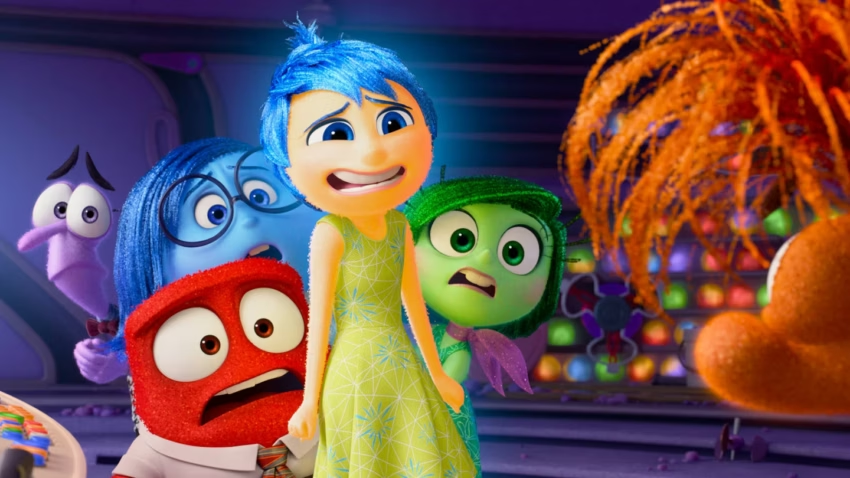
Inside Out 2 picks up two years after the first movie. Reily’s thirteen now, and she’s dealing with everything that comes with being a teenager — complicated relationships, confusing changes, and the introduction of several new emotions.
The most prominent of these is Anxiety, who now rules Reily’s intellect with an intentional chaos brought on by much planning and her ever-present concern for the worst-case scenario. Anxiety quickly determines that Reily’s original emotions are rather useless and has them banished to the back of Reily’s subconscious, where they can be repressed without interfering in her plans.
Meanwhile, Riley faces the transition from middle school to highschool with a series of looming challenges. As a hockey player, she dreams of getting on her high school’s highly competitive team. So she enrolls in a three-day hockey camp run, hoping to make a good first impression on the team’s coach before she even gets to high school.
Throughout camp, her competitive nature increases. Soon she’s willing to sacrifice almost anything for her chance to be on the team, the whole time pushed by Anxiety to do more. The mounting pressure finally explodes in a panic attack on the bench after she learns that the coach has already determined that she’s not ready for the team. With one final chance at changing her coach’s decision, Riley enters the camp’s last game without any reservations.
But internally, Joy and the other original emotions are finally taking back Riley’s mind. At last, Anxiety is displaced and it is only once Riley rediscovers her love for hockey that she is able to make the winning shot that might just change the coach’s mind.
She spends the next few days with ever-present but no longer dominating Anxiety, who is comforted by the other emotions while they all await the email that will tell her whether or not she made it on the team. When it finally arrives, it comes with good news, and the movie ends with Riley’s excited smile.
Inside Out 2
This movie is nothing if not relatable. The setup, plot, conflict, and characters were all so realistic and believable that I found myself carried along and quite enjoying the story, despite my reservations after the first movie’s conclusive ending. Instead, the story used Riley’s new emotions to answer some critical questions about identity, the role of anxiety, and whether or not it can be helpful.
For the most part, I loved how the movie handled these questions. They dealt with each one using nuance and realism, advocating for control of emotions without repressing them. The writers faced many of the real fears and questions anxiety often raises in real life, not shrinking from the fact that sometimes unpleasant emotions can be helpful or that not every feeling is legitimate. The story addressed head on how much anxiety is helpful, when it is too much, and whether or not having no anxiety at all is a good thing.
But one question remained unanswered. Namely, what happens when anxiety is right?
So far, we’d seen Anxiety cause a whirlwind of emotion in Riley’s mind. We’d also seen her solve several problems with foresight and preparation. But we hadn’t seen what happens when anxiety attempts to prepare for a disaster in an unhealthy way, and then that disaster happens.
But nearly everyone can come up with a time when anxiety was right — when they pushed away a thought of worry or doubt and it turned out to be true, often with devastating results.
The movie did such an excellent job of answering so many questions around anxiety, and yet avoided this one completely. And I don’t think this would have been quite as noticeable if the conclusion had not allowed for such a clear opportunity to answer these questions. What if Riley had gotten the email, but it informed her that she didn’t make the team? What would she do then? How would the other emotions react? Would Anxiety resurface after being proven right?
The movie didn’t offer — or didn’t have — an answer. And I understand why. It can be a really difficult possibility to deal with. But people deal with it in real life all the time. And stories like this one are supposed to offer answers.
What do you do when acting on hope is the right thing to do, but it falls through? How do you address the reality that despite dealing with an insecurity well, it can often turn out to be real in a painful way? How do you recover from a failure that you did everything you could to prevent?
The conclusion was set up to deal with each one of these questions, and yet the writers dodged them entirely by offering a simpler ending.
So what can we learn from Inside Out 2?
Don’t run from hard questions.
Before you even start plotting, look at your premise, your theme, and your characters, and map out the questions they each ask. A lot of these you’ll be able to figure out intuitively. They’ll end up being written into your plot and story without you really thinking about it.
But others will be more subtle, more difficult, but no less acknowledged by your audience. And it’s those questions that so many stories wave away or ignore, that will give your story a unique layer of depth and meaning.
So if your story asks something challenging, lean into it, dig deeper, and come up with a philosophy that fairly addresses that issue. If you’re given the option between an easy out and a more difficult situation, pick the one with difficulty.
Your readers deserve as much.
Because although they come to stories to be entertained, encouraged, and even occasionally educated, at their core stories are opportunities to share truth. They are created for the purpose of answering hard questions with goodness, giving their readers ways to understand their own lives and stories better while helping those around them.
So despite the difficulty of answering these questions, don’t be afraid to press into them, to investigate exactly what makes them so difficult, and address that conflict with wisdom and grace. Not only will your readers close your book with much more satisfaction, but your story will also be richer for it.



Let us know:
What stories have you noticed ignore crucial questions? What stories have you seen tackle them head-on?


Hi! My name is Mara, and I’m a Christian artist, violinist, and blogger. I remember the day that I decided that I would learn something new about what makes a good story from every book I picked up — whether it was good, bad, or a mixture of both. I use this blog as a way of sharing some of the tips and tricks I’ve learned, and highlight which books, cartoons, and movies have taught me the most about writing an awesome story.