
Some of my favorite stories are those that trace their plot through multiple generations. We see the actions of the parents affect their children, and the choices their children make influence those who come after them. The audience is offered a front row seat into multiple perspectives, unbound by time.
The impact of these stories is magnified, particularly in terms of their conflict and theme. The scope of their conflicts are shown to be wide-reaching and vast, ultimately impacting multiple generations. They are also rich with parallels that serve to strengthen the themes running through the narrative. But — perhaps most poignantly — these stories are powerful because they are true to life.
There is a lot that could be said about multigenerational stories, which is why for this article, we’re going to be investigating three case studies side-by-side. Rather than focusing on any one in particular, we’re going to take an overview of multigenerational stories in general in my final post for the Story Fortress.
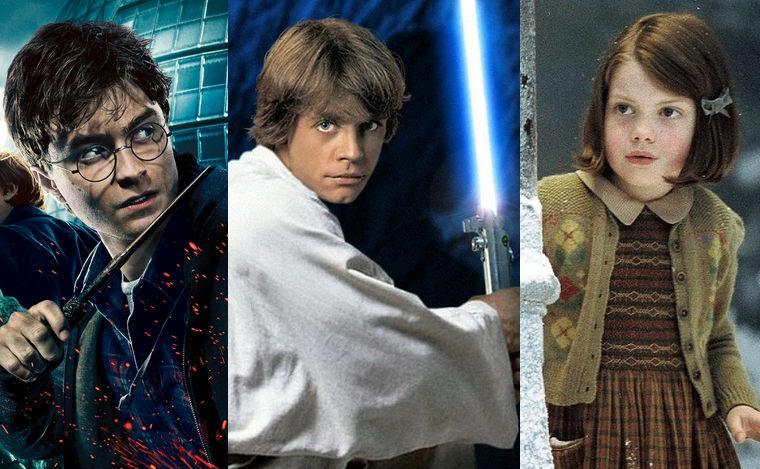
Star Wars, Harry Potter, and the Chronicles of Narnia
Luke Skywalker inherits the lightsaber his father lost after turning to the Dark Side. Lucy Pevensie finds the lamppost that Diggory left and defeats the White Witch he helped bring to Narnia. Harry Potter faces the aftermath of the school conflict from his parents’ generation.
I love these stories because the protagonist’s perspective is just a piece of the puzzle. As we learn more and more about their parents’ history, we see more fully that the significance of the events happening around them far surpasses the immediate conflict our protagonists face. When Lucy and her siblings end the White Witch’s reign, they’re putting down a curse that one of their own — a son of Adam and a daughter of Eve — brought about accidentally over a hundred years ago. When Harry Potter faces Voldemort one final time, he’s looking at the man who terrorized and killed half of his parents’ generation.
When Luke extends hope to Darth Vader, he isn’t just forgiving his enemy. He’s giving the Chosen One a chance to redeem himself and finally fulfill his place as the one to restore balance to the Force. If he succeeds, he’ll have helped fulfill the prophecy and take down the Empire that has terrorized a galaxy for decades. If he fails, a sinister tyranny that began its grab for power centuries before will continue, unopposed.
Our Multi-Generational Story
Without understanding the background to all of these events, we wouldn’t see the full picture of what these stories mean. Thus, by writing conflicts that transcend generational boundaries, the authors magnify the scope of their story’s conflict.
In each of these stories, the force of evil the protagonists oppose isn’t just a passing villain. They are antagonists that others literally lived and died fighting. There is no guarantee our protagonist’s generation will be the one to succeed. And even if they seem to, at first, the audience is given no assurance they will see the villain’s final downfall, even if a temporary victory seems to appear. Thus when the audience is given that resolution, their satisfaction is that much more powerful.
On top of that, by using multigenerational stories, the authors give us a picture of how powerful and prevalent their story’s theme is. The ideas they present aren’t only for a certain time or place, but rather timelessly applicable truths.
But perhaps the most powerful aspect of multigenerational stories is that they are true to life.
Every single one of us, no matter where we come from or where we end up, are all part of a long, multi-generational story. The conflicts and inspiration we experience are often both direct consequences of our parents’ generation, and the choices we make today will personally and powerfully impact our children.
As storytellers, we experience this truth especially. The writings of the authors who came before us guide us, caution us, and inspire us. Without them, resources like this blog wouldn’t exist. That first book that made you fall in love with reading would have never been written. The lessons we learn from every story we read would have never been taught. The wisdom and experience of the writers who came before us make the stories we tell today not only far better than they would have been otherwise, but also possible to begin with.
And at the same time, the words we contribute, the books that we write, will fuel the next generation of creatives. It’s our turn to carry the torch so that those who come after us will experience the same inspiration that started each of our journeys.
That’s what I hope to leave you with.
Because even though this seems like the end — and in some ways it is — in reality, it’s only the beginning. I’m just getting started, both in my fiction and nonfiction. I have so many ideas and projects on the horizon that I can’t wait to share with all of you. Just because this chapter is closing doesn’t mean I’m going anywhere.
So my challenge to you is to pick up the torch. Every single one of you have projects, a work in progress, and if nothing else, an idea that won’t leave you alone. If you’ve been teetering on the edge of starting a new platform, or considering taking your writing to the next level, this is your moment. Don’t let anxiety or indecision quell the unique creative spark that you — and only you — have been given.
The world desperately needs strong storytellers, now more than ever. They are the conscience of our society, warning, convicting, and inspiring the next generation of philosophers, poets, theologians, and leaders. I’m trusting you to take our place with whatever your passion is and carry on what the Story Fortress started — which really began long before Sophia and I put pen to paper over three years ago.
The choices we make today, the truths we choose to tell (or to stay silent on) will directly impact the generations to come. Multigenerational stories are powerful because they emphasize the reality that the results of the conflicts we face today matter and the truths we share along the way are genuinely timeless.
And the truth is that you don’t have a choice about whether or not you’re a part of this multi-generational story. Your creative spark has thrust you into the spotlight of storytellers and visionaries, with all of the responsibilities and opportunities that come with it — including a new generation of upcoming writers who are counting on you.
But the choice you do have is whether or not you take up the torch, carry on the legacy of the many authors who came before us, and inspire the generations who come after.
I know what I’ll pick, both through the Story Fortress and beyond it.
So now the choice is yours.
The only question is:
What are you going to do with it?



If you want to join me in the next chapter of my writing journey, you can sign up for my email list here. Thank you guys for sticking with us, and keep writing in the meantime!

Hi! My name is Mara, and I’m a Christian artist, violinist, and blogger. I remember the day that I decided that I would learn something new about what makes a good story from every book I picked up — whether it was good, bad, or a mixture of both. I use this blog as a way of sharing some of the tips and tricks I’ve learned, and highlight which books, cartoons, and movies have taught me the most about writing an awesome story.
This article is beautifully written and so inspiring. Thank you for sharing that encouragement, Mara.
I appreciate this article, as well as the entire Story Fortress. I’ve read nearly every article on here, though this is my first (and last) time commenting. Thank you both!