
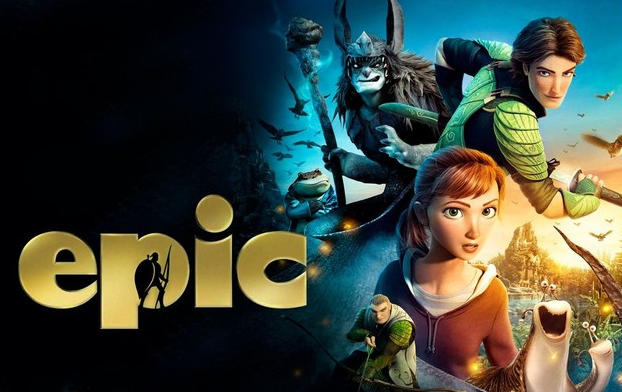
Subverting expectations is a really powerful tool you can use as a writer. Whether that’s in the form of a plot twist or just a genre-defying trope, it’s one of the fastest ways to generate variety and interest in your story. Whenever your reader thinks they know where the story is headed… you switch it up on them.
This technique has led to some of the most entertaining stories in fiction. But there is a possibility for you to take it too far.
Letting your plot end exactly how your readers envisioned can generate powerful payoff to the conflict and tension you’ve built throughout the story. And failing to do that can leave your readers feeling like you’ve broken the promise you made to them, whether you did that through your genre, premise, or setup.
So how can we walk that balance? How do we know when it’s all right to subvert expectations? What promises are we allowed to break?
This week we’re diving into the animated fantasy movie Epic to answer just that.
Epic
Seventeen-year-old MK’s world is turned on its head when her mother passes away due to cancer. In just a few weeks she’s shipped off to stay with her estranged eccentric father, who lives alone in the woods. There, he spends his days searching for evidence of a society run by tiny beings he’s convinced live and operate right under everyone’s noses.
MK scoffs at his claims just like everyone else — until she’s transported to their world.
When the queen of the forest is killed in battle with the evil Boggans who’ve set out to destroy every sign of life, she realizes the forest only has one hope. So she enchants a flower pod with the power to choose her heir just before her death.
It chooses MK.
In an instant, she’s entrusted with the protection of the queen’s last possession, the enchanted pod, and shrunk to the size of the people she didn’t think were real just a few minutes ago. Now they’re her only protectors in a new and incredibly dangerous world. The Boggan army is rallying for their final strike. With the queen dead, all they have to do is kill the pod, and they’ll be able to conquer the forest unchallenged. That makes MK their prime target.
Ronin, the captain of the army, and Nod, his teenage ward and soldier-in-training, guide MK as she journeys to the forest to discover the truth of the queen’s last wishes and make sure the pod chooses a permanent heir without Boggan interference.
To do that, the pod must bloom in full moonlight. Although it only barely survives the dangerous journey through the woods and into the night, more challenges lay ahead. The Boggan army uses bats to block out the moon’s rays, stopping the pod from blooming. As the pod begins to die, Nod and the others rally their forces for a final battle against the Boggans.
But MK gives them the advantage that they need. She contacts her father, brings him to the pod, and he is able to deter the bats, drawing them away from the pod just long enough for it to bloom.
MK makes it back just as the pod is choosing the next heir. And it chooses… a random girl we’ve seen once or twice.
At the same time, it gives MK the ability to go home, pulling her from Nod and the others until she’s back in her own world again.
Breaking Your Promises
I know I’m not the only one who assumed MK would become queen of the forest in the end. There’s fan art of what she would look like as queen, theories of how the movie would have ended if things had gone differently, and an audience of people who felt like they missed out.
Throughout the story, the supporting characters tell MK over and over again that she was brought into this new world for a purpose — even if she can’t see what that purpose is yet.
And sure, MK’s role in the climax was important in a technical sense. But up against heroes who faced their foes in combat and fell through the sky in battle, contacting her father and getting his help seemed relatively insignificant. On a purely practical level, her role was important. But from the audience’s perspective, we expected so much more from someone who was told her seemingly ill-fitting place in the story had a deep purpose.
We thought we’d get to see that purpose manifested when she was chosen as queen, but that didn’t happen.
I think I know what the writers were trying to do here.
Everyone would expect the girl from another world who was brought there “for a purpose” to end up being the queen, in the same way our protagonist often turns out to be the lost heir or the secret talent. Like we talked about in this article, playing into those stereotypes and assumptions can be incredibly detrimental to your story. When you fulfill every one of your audience’s predictions, your story will lack variety and feel predictable.
I think in many ways the writers felt it would be a cop-out. A random girl is brought to a forest currently on the hunt for their new heir? Of course she’s the queen. It felt too predictable, too simple. They wanted a complex, unique reason to bring their protagonist into this new world.
But the audience didn’t want that. They craved a payoff after a story that dealt with tragedy, suffering, and death. They wanted to see the romance hinted at between MK and Nod come to a fulfillment. And even more than that, they wanted to understand the profound meaning so many characters implied when they insisted that MK came for a purpose.
The audience didn’t end up getting any of that. Instead a random girl got the title of queen, the romance was cut short, and MK’s role was surprising simple and not nearly as profound as we anticipated.
In short, by subverting our expectations the writers also broke their promises.
So how do you keep a balance between the two?
There are two big principles to keep in mind.
1. Don’t Mess With Conclusions
Readers get really touchy about their conclusions. They want to see their characters happy, fulfilled, and rewarded for their actions. They want closure after a long story of suffering and conflict. If you’re subverting the expectations of your readers, don’t wait until the last minute to do it.
Instead, subvert their expectations earlier (even if that just means moving the big reveal to right before the climax, rather than after) and then use the remaining time to build up to the conclusion as it’s intended to be. Conclusions are only satisfying if they function as payoff to buildup. If you don’t have that, your ending won’t feel conclusive or even satisfying. So make sure your readers have time to adjust to the new world you’ve set up with your plot twist or surprise before they settle in for the conclusion. Even if that’s just a few chapters, that will make a big difference.
An example of a story that did this really well is Gravity Falls. It features a complex mystery with multiple plot twists. Instead of dumping that all on the viewer in the last few episodes, which would have felt disorienting and inconclusive, they revealed parts of their mystery throughout the series to have time to build up to their real conclusion.
One of the biggest plot twists (Gruncle Stan’s secret identity and the true author of the journals) was revealed half way through season 2, so that the rest of the series could be spent building tension toward the climax. While you don’t have to include your reveal that early, it was incredibly helpful in fleshing out new characters and focusing tension very carefully at the climax, rather than the peripheral mysteries the show had also followed.
2. If You Break Your Promises, Make It Worth It
If you aren’t messing with your reader’s conclusion but still want to break some pretty significant promises, make sure the payoff is worth it. Let the new situation be more than what you initially promised, rather than less. Readers will be much more inclined to accept and even enjoy the new situation more if you deliver more than you promised.
An example of a story that did this really well is The Hunger Games. Every single time that story broke the reader’s expectations — from “if it weren’t for the baby” to the corruption inside the rebellion itself — the revelation didn’t take away from the story without adding something significantly more. And that could be tension, conflict, antagonists, allies, or thematic developments. It doesn’t really matter what you start with, as long as you substitute it with something greater.
Case in point: You thought the livestreamed interviews of the Hunger Games champions were stressful? Just wait until Peeta starts compulsively lying to millions of viewers on live television — and they all believe him.
Epic simply didn’t do this. It broke the promise that MK would become queen (which would have made the ending more satisfying), but failed to substitute that promise with anything else, let alone something that would have made the ending feel more satisfying. Calling your father to scare away bats simply doesn’t measure up to being granted a royal title that comes with supernatural powers.
If you want to break your promises, it’s more than doable. In fact, it can keep your story fresh and vibrant where it otherwise would have grown predictable. But it must be done carefully. Every time you set out to subvert expectations, remember that necessarily comes with breaking promises you made to your readers. The power of a promise kept to a reader is often overlooked and downplayed because it can seem simple and basic from the writer’s perspective, but this element can be no less powerful than a plot twist. The right promise fulfilled gives your readers a level of satisfaction that they won’t get anywhere else. So subvert your reader’s expectations if you have to, but make sure you do it with intentionality.



Let us know:
What other stories have you seen breaking their promises to subvert expectations? When did it work, and when did it fail?


Hi! My name is Mara, and I’m a Christian artist, violinist, and blogger. I remember the day that I decided that I would learn something new about what makes a good story from every book I picked up — whether it was good, bad, or a mixture of both. I use this blog as a way of sharing some of the tips and tricks I’ve learned, and highlight which books, cartoons, and movies have taught me the most about writing an awesome story.